
Skincare guide
How Do Pimple Patches Work?
2 September 2026
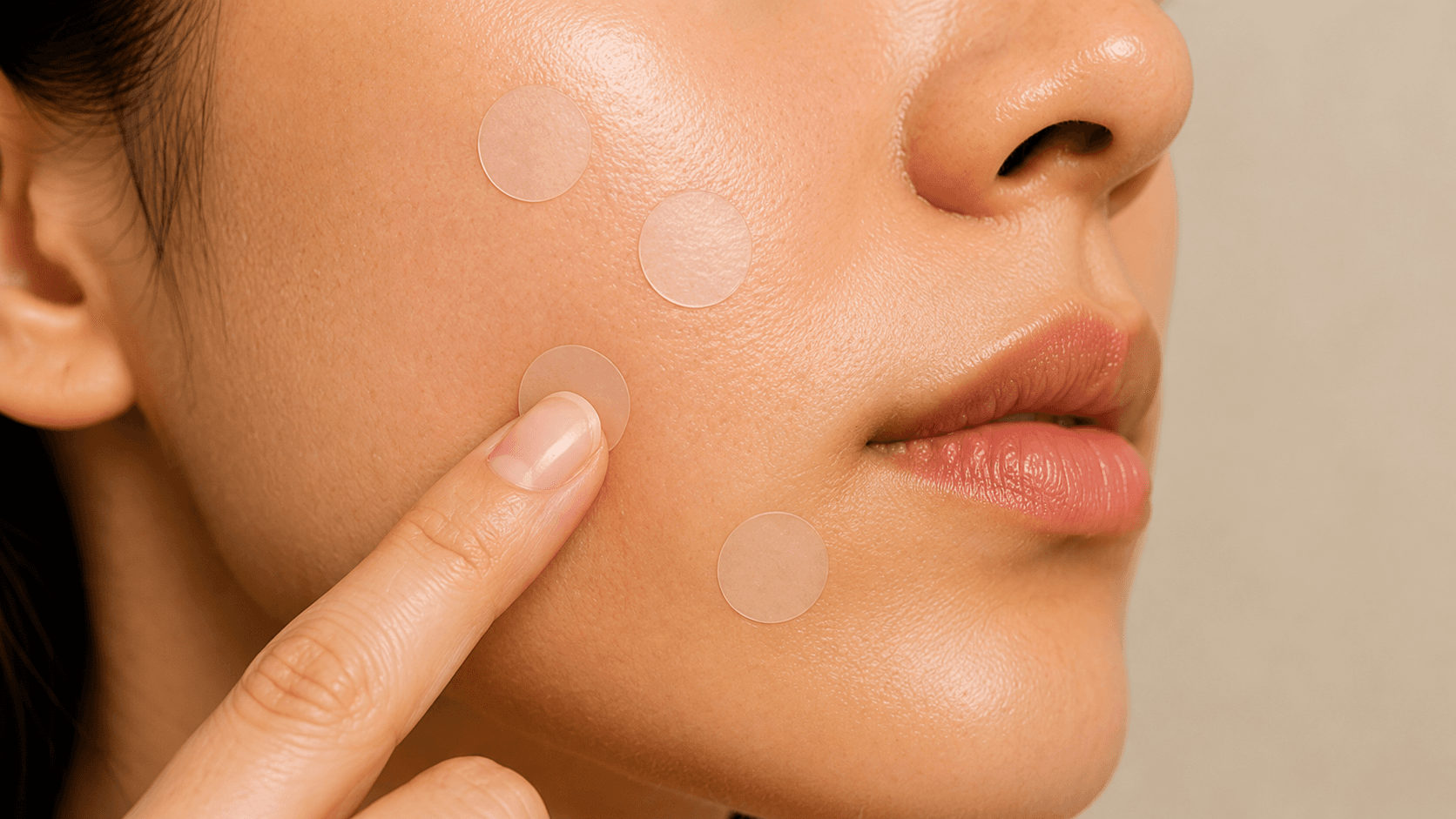
A pimple patch is usually a small hydrocolloid dressing. You place it over a blemish so it can soak up fluid from the surface and keep your fingers off the spot. That covering is the useful part. It is not a treatment for acne as a whole, and it will not stop the next pimple from forming.
What a pimple patch actually is
Most of the thin stickers sold as pimple patches are a miniature wound dressing. Cleveland Clinic dermatologists describe them that way: a covering for a particular kind of spot, not a cream that treats the skin more broadly.
Hydrocolloid is a family of materials that take up water and turn into a gel. Chemically, they are long-chain polymers. Carboxymethylcellulose, gelatin and pectin are common examples. In a patch, that gel-forming layer sits against the skin. A thin outer film, often polyurethane, holds it in place and keeps the area covered.
Some patches add extra ingredients, such as salicylic acid or tea tree oil, or tiny dissolving needles meant to carry those ingredients farther. Those are different products. This guide is about the ordinary unmedicated hydrocolloid patch: the kind that works mainly by absorbing fluid and covering the blemish.
How hydrocolloid does the work
When a suitable blemish leaks fluid, pus, oil or watery exudate, the inner layer mixes with that moisture and gels. In wound care, that gel helps keep the surface moist and protected, while the outer film keeps dirt and repeated touching away from it.
On a pimple, the same idea applies, with limits. If there is fluid near the surface that the patch can reach, some of it can move into the dressing. The covering also makes it harder to squeeze, scratch or pick. That last point matters. The American Academy of Dermatology warns that popping and picking can push material deeper, raise inflammation and leave a higher risk of scars and dark spots.
What the patch is not doing is pulling toxins or deep impurities out of the skin, killing all acne-causing bacteria, or fixing the clogged pores and oil production that lead to new breakouts. Cleveland Clinic is direct about this. For overall acne treatment, there is little use for pimple patches. They cannot prevent acne from arriving, and they do not clear the clogged pores that start many flares.
The research specifically on hydrocolloid patches for acne is thinner than a lot of product copy suggests. A 2025 review in the Journal of Clinical Medicine found only a handful of studies. One was a 2006 pilot with 20 people over a single week. Those who wore a hydrocolloid acne dressing improved more, on mild-to-moderate inflammatory acne, than people given ordinary skin tape. That is a useful signal. It is not proof that patches clear acne. The reviewers' own conclusion is the honest one: early reports suggest the absorbent dressing may help some fluid-filled surface lesions, and more clinical research is needed.
Why the patch turns white
As hydrocolloid takes up moisture, it gels, and the dressing often looks cloudy or white. That is the material holding fluid. It is not a sign that toxins have left the skin. A patch can also pick up moisture from damp skin, sweat or leftover cream, so a white patch does not always mean a large amount came out of the pimple itself.
When the centre has turned opaque, or the edges have lifted, it is usually time to take it off and throw it away.
What they are useful for, and what they are not
Ordinary hydrocolloid patches tend to help more on superficial blemishes, especially ones that contain fluid or have a visible head. A whitehead that has come close to the surface, a pustule, or a spot that has already opened can give the dressing something to absorb.
Cleveland Clinic notes they are most effective over open, oozing zits, with some evidence they can also reduce the size and redness of some closed pimples. That word "some" is doing real work. A closed bump with little fluid at the surface may flatten a little. It may also look much the same in the morning.
Blackheads are a different problem. They are clogged pores with a darkened open top, not a pocket of fluid sitting under a sticker. A standard hydrocolloid patch does not offer much help there.
Deeper lesions such as nodules and cysts sit farther down. A thin dressing on the surface generally cannot do much for them. If a deep, painful lump has opened and is draining, a patch can still act as a cover so you are less likely to keep touching it. That is wound covering, not treatment of cystic acne.
If a pimple has already been popped, a patch can be a practical cover for the open skin. It can take up leftover drainage and keep hands off while the surface settles. That does not make popping a good idea.
How to use one
Read the instructions on the pack you have. Timing and sizes differ from brand to brand.
Wash the area gently, then dry it fully. Hydrocolloid adhesive does not hold well on wet or creamy skin. Wash your hands before you handle the patch. Place it so the sticky side covers the blemish, press the edges down, and leave it alone for the time the manufacturer suggests. Many are meant to stay on for several hours. A lot of people wear them overnight.
Take it off when you reach that time, or sooner if it has turned white and loose, looks dirty, or is irritating the skin. Use a fresh patch if you still want one on. Do not stick a used one back on.
If your skin is sensitive to adhesives, or a patch stings, itches or leaves a rash, stop using it. Some formulas also include drying ingredients such as salicylic acid or tea tree oil, which can irritate an already angry spot. Repeated sticking and peeling can also bother thin or easily irritated skin.
Skincare under or over the patch
The dressing needs to sit on the blemish, not on a film of serum, moisturizer or oil. Product underneath often stops it sticking. The patch may also soak up that product instead of the fluid you wanted it to take up.
You can still use the rest of your routine around the patch. After you take it off is a better moment for a spot treatment, if you use one. There is no special ceremony. Clean, dry, patch on, leave it, then continue as usual.
When a patch probably will not help
A deep, sore lump with no head is a poor candidate. So is a face of blackheads, or a red bump that is not producing fluid. A sticker will not keep new pimples from arriving, and putting patch after patch on skin that is already raw from picking or from the adhesive is more likely to aggravate it than to help.
If a patch is not flattening the spot after a wear or two, stop putting one on that same lesion. The skin may need something other than a dressing.
If acne keeps coming back
A pimple patch is a covering for a spot. It is not a plan for acne that returns, spreads or hurts. Recurring acne is usually handled with treatments that act on oil, clogged pores, bacteria and inflammation over weeks, or with care from a clinician. It is not handled by putting a sticker on each new bump.
The American Academy of Dermatology recommends seeing a dermatologist when acne is deep and painful, when it is leaving scars or dark spots, when it will not clear, or when it is affecting how you feel day to day. If that sounds familiar, a qualified healthcare professional can advise you. A patch can still cover an individual blemish in the meantime. It should not stand in for that advice.