
Skincare guide
Sunscreen vs Sunblock: What's the Difference?
2 September 2026
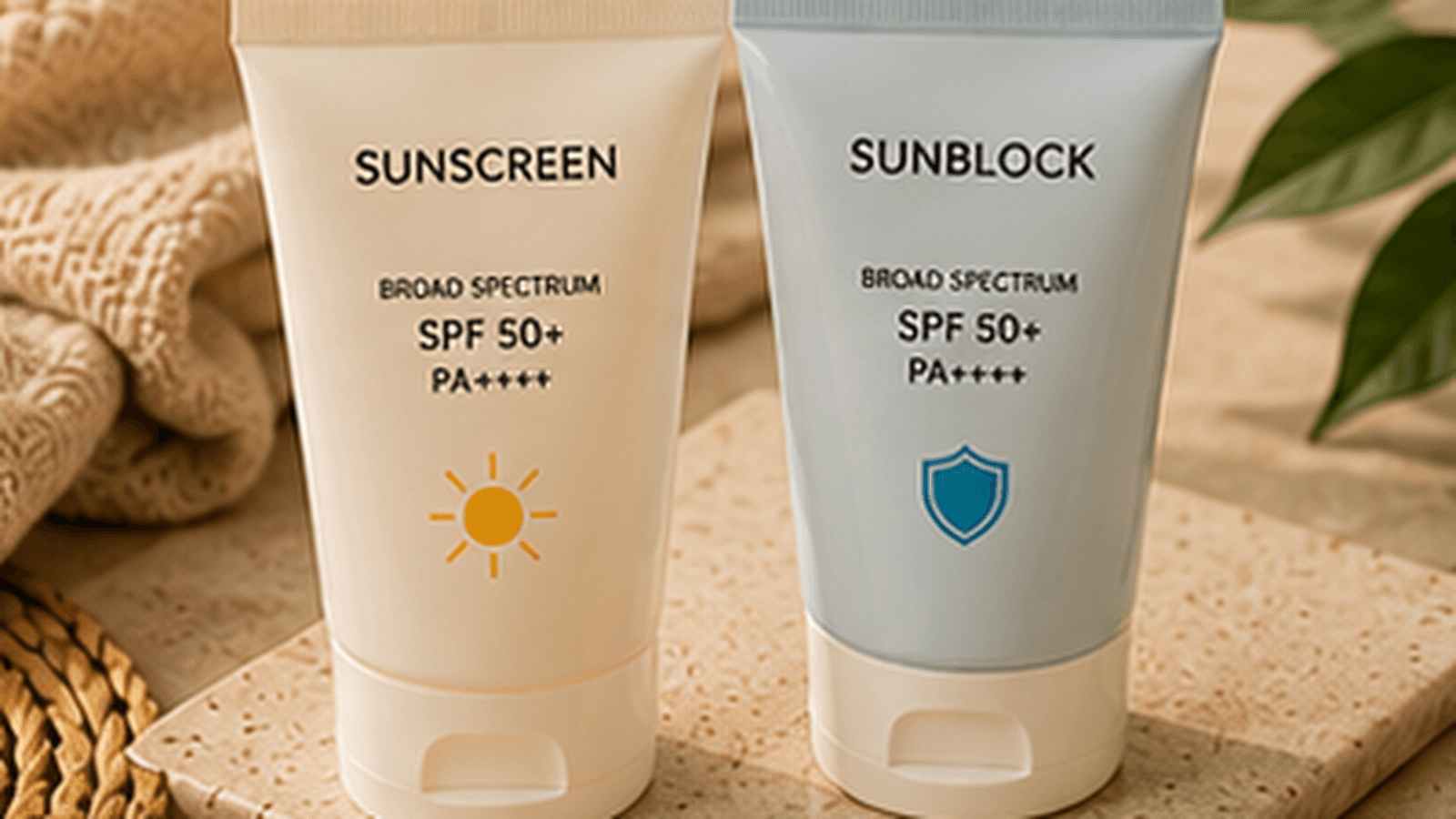
In shops here, people still ask for sunblock. The bottle often says sunscreen. They are trying to buy the same job: something you spread on skin so less ultraviolet light gets through. The older word stuck. The chemistry on the label moved on.
So the useful question is not which word is fashionable. It is what the product actually does, and whether you are putting on enough of it.
Why the two words exist
"Sunscreen" is the ordinary name for a product that reduces UV reaching the skin. "Sunblock" grew up as everyday language, especially for thicker, often mineral, creams that left a white cast. In Pakistan that second word is still the one many people search for and say out loud.
Modern regulators do not treat sunblock as a separate, stronger category. In 2011 the U.S. Food and Drug Administration told manufacturers they could not label over-the-counter products as sunblock, waterproof or sweatproof, because those claims overstate what a cream can do. No film on the skin blocks every ray. Water and sweat still take it off. The honest term on a U.S. label is sunscreen, with water resistance measured for 40 or 80 minutes if the product earns it.
Other countries write rules differently. You may still see "sunblock" on a pack sold locally. That is branding and habit. It is not a promise of total cover.
Two kinds of filter, one job
The active ingredients fall into two broad groups. Organic filters, often called chemical filters, include names such as avobenzone, octinoxate and homosalate. Mineral, or inorganic, filters are zinc oxide and titanium dioxide. Some bottles mix both.
The school-book line you still hear is that chemical sunscreen absorbs UV while mineral sunscreen bounces it away like a mirror. That is too neat. The American Academy of Dermatology's current consumer advice is that chemical, mineral and hybrid sunscreens all form a layer that absorbs UV. Mineral filters also reflect some of the rays. Absorbing is the main job for both families. The white cast on a zinc cream is leftover pigment, not proof that the product is a shield and the other kind is a sponge.
For everyday use, pick a texture you will repeat. Oily or acne-prone skin often prefers a lighter gel, fluid or "dry-touch" cream rather than a heavy lotion. Mineral formulas can feel thicker and look paler, though micronised versions are less obvious than they used to be. Sensitive skin sometimes tolerates zinc oxide or titanium dioxide better. If a formula stings or brings up closed bumps, switch texture rather than giving up on sun protection. None of that changes the UV physics. It changes whether you will put it on again after lunch.
UVA, UVB, broad spectrum, SPF
UVB is the shorter-wavelength light that more readily burns the surface. UVA reaches deeper and adds to tanning, ageing of the skin and some of the damage that leads to skin cancer. You want both.
SPF, sun protection factor, is mainly a measure of UVB / sunburn protection. A higher SPF means more of that protection when the product is applied at the amount used in testing. It is not extra hours in the sun. The FDA is explicit: SPF does not scale with time of day in a simple "SPF 30 means 30 hours" way. Midday sun in a bright climate is stronger than late afternoon. Geography matters. Pakistan sits with plenty of high UV through much of the year. That is a reason to use enough product, not a reason to hunt a mythical total block.
Broad spectrum means the formula also covers a meaningful share of UVA, in proportion to its UVB protection, under the test the FDA described. Look for that wording, or the local equivalent, rather than the word sunblock. The American Academy of Dermatology recommends SPF 30 or higher, broad spectrum, and water resistance if you will sweat or swim. FDA's consumer pages talk about SPF 15 as a minimum for reducing sunburn; dermatology groups usually aim higher because people under-apply.
How much, and how often
Most adults need about an ounce, a shot-glass fill, for skin that clothing does not cover. For the face, the American Academy of Dermatology says at least a teaspoon, roughly the length of your index and middle fingers. A thin smear that disappears on first contact is usually too little. The SPF on the bottle assumes a tested thickness. Use less and you get less.
Put it on about 15 minutes before you go out. Reapply about every two hours outdoors, and after swimming or heavy sweat. Water-resistant does not mean you can skip that. There is no waterproof sunscreen. The FDA banned that word for the same reason it disliked sunblock: it sounds finished when the job is not. If you wash your face during the day, the film has gone. Put it on again. A high SPF is not extra hours of cover. SPF 50 still needs a proper layer and a second pass when you are outside for long.
Hats, shade and covering up still do part of the work, especially in the middle of the day. Sunscreen is one layer. It is the layer you can carry in a bag. Call it sunblock if that is the word you grew up with. Use enough of it either way.