
Skincare guide
How to Remove Blackheads From Your Nose
2 September 2026
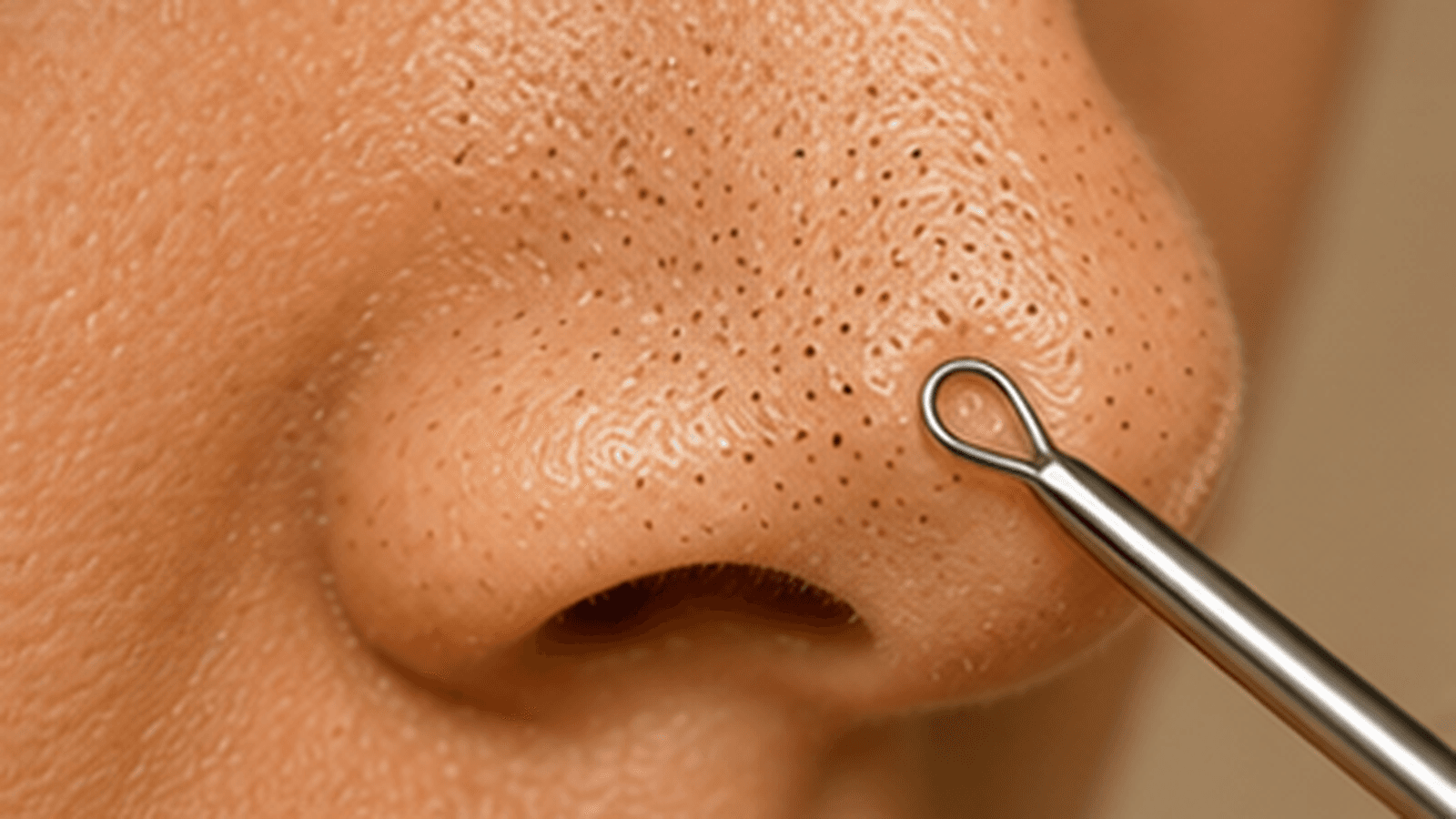
The dark specks on the nose are not dirt. Scrubbing harder will not wash them off, and a morning of squeezing usually makes the area redder without solving much. A blackhead is a clogged pore that stayed open, so air can reach the plug. The colour is oxidation of oil and dead skin, which is why it looks dark.
That is the American Academy of Dermatology's point, put simply: resist the urge to treat a blackhead like grime. The pore is already full. What helps is loosening that plug over time, not scraping the surface.
What a blackhead is
Dermatologists call blackheads open comedones. Oil (sebum), dead skin cells and other debris collect in a hair follicle. If the top stays open, you see a dark spot. If the same kind of plug is sealed over, you get a whitehead instead.
They are a form of comedonal acne, not a separate mystery condition. They also are not the same thing as a red, sore pimple. An inflamed papule or pustule has swelling and, often, pus. A blackhead is a clog. It can sit there quietly for a long time.
The nose is a common place for them because the T-zone, the strip across the forehead and down the nose, has more sebaceous glands and tends to look oilier. Cleveland Clinic dermatologists describe that pattern clearly. Bigger-looking pores in the centre of the face are ordinary anatomy, not a sign that the pores are "open" in some special way.
Blackheads, filaments and pimples
A lot of what people squeeze from the nose is not a blackhead. Those thin grey or yellowish threads that refill within a day or two are often sebaceous filaments: a normal lining of oil in the pore. They sit fairly flush with the skin. Emptying them does not "clean" the pore. It just empties a structure that is meant to be there, and it can inflame the skin.
A true blackhead is usually darker and a little more raised. It is an actual plug. Inflamed acne is different again: red, sometimes painful, sometimes with a head of pus. Treatments overlap, but they are not interchangeable. A hydrocolloid sticker, for example, is built to sit over fluid, not over a dry open plug.
That is why pimple patches are a poor match for blackheads. A standard patch can help a fluid-filled spot. It does very little for a darkened open pore.
What actually helps
There is no honest five-minute method, even though people search for one. A strip or a squeeze can make the surface look emptier for a day. The follicle is still making oil. Cleveland Clinic's advice is patience: the clog took time to form, and it takes time to loosen. Consistency matters more than a dramatic session at the mirror.
Start with gentle cleansing, once or twice a day. A mild cleanser is enough to take off oil, sunscreen and pollution. Hot water, grainy scrubs and repeated rubbing do not unclog the pore. They irritate the surface, which can drive more oil and more redness.
Salicylic acid is the ingredient dermatologists reach for first on blackheads. It is a beta hydroxy acid. It is oil-soluble, so it can work inside a greasy pore rather than only on the surface. Cleveland Clinic often suggests a salicylic acid wash around 2% to 4%, once a day to begin with. If the skin feels tight or flaky, use it less often or drop the strength. Medicated pads exist too. They are still an acid, not a shortcut.
A retinoid is the other main approach. Adapalene is available without a prescription in many places. Stronger options such as tretinoin need a clinician. Retinoids help skin cells shed more evenly so they are less likely to pack inside the follicle. The American Academy of Dermatology recommends a retinoid for blackheads and whiteheads, and says to give treatment six to eight weeks. The area can look drier and a little flakier before it looks clearer. That is expected. It is not a reason to add a harsh scrub on top.
A simple split many people tolerate is salicylic acid in the morning and a retinoid at night, with a moisturiser and sunscreen. You do not need five acids at once. If the skin stings, scale back. Azelaic acid is a milder option some dermatologists mention for sensitive skin. It is usually less targeted at blackheads than salicylic acid or a retinoid.
Benzoyl peroxide is more useful for inflamed pimples than for blackheads themselves. Cleveland Clinic notes that it does not clear blackheads the way salicylic acid or retinoids do, though it can help if you also get red breakouts.
What people try that does not last
Pore strips feel satisfying because they lift some of the dark plugs you can see. Cleveland Clinic describes them as a temporary clear for an event, not a treatment of the clog underneath. The adhesive can also leave the skin dry and irritated. The dots often return.
Home extractors and pore vacuums have the same problem, with extra risk. A metal loop or a suction gadget can bruise, break tiny blood vessels and inflame the follicle. That is not the same as a clinician doing a comedone extraction with sterile tools after looking at the skin. Cleveland Clinic is blunt: leave extraction to a professional if you need it, because amateur squeezing can scar.
Squeezing with fingernails is the version most people already know is a bad idea and still do. The American Academy of Dermatology warns that popping and picking can push material deeper, raise inflammation and leave a higher chance of scars and dark marks. On the nose, where the skin is already oily and often picked at, that risk is not theoretical.
Pores do not open and close
Steam, ice, hot cloths and "pore-opening" routines are built on a picture of the skin that is not true. Pores do not have muscles. They cannot snap shut after a splash of cold water. Heat can make the surface look a little more swollen, which sometimes makes a plug easier to see. It does not unlock a door.
Products that claim to detox pores are using a word that does not mean much here. A pore is not storing toxins. It is a follicle that can fill with oil and skin cells. You can reduce how often that happens. You cannot purify it.
Why they come back
Oil production and cell turnover do not stop because you cleared one plug. That is why blackheads recur, especially on the nose. A cream that promises permanent removal is selling something the skin cannot do. Maintenance is the honest version: a cleanser you will actually use, a salicylic acid or retinoid you can tolerate, sunscreen, and leaving the area alone with your fingers.
Makeup and heavy creams that clog follicles can add to the problem. Noncomedogenic on a label is not a guarantee, but it is a reasonable thing to look for if blackheads bother you. Sun exposure can also worsen inflammation and oiliness, which is one reason a daily sunscreen still belongs in this routine.
When to get help
If you have given a simple routine six to eight weeks and the blackheads are still dense, a dermatologist can offer a stronger retinoid or a professional extraction. See someone sooner if the area is painful, heavily inflamed, scarring, or if squeezing has already left dark marks you cannot settle.
This is ordinary comedonal acne for most people. It is not a medical emergency. It also is not dirt, and it will not vanish because a tool promised instant pores. Treat the clog kindly, keep doing it, and stop digging.