
Skincare guide
How to Use Retinol Serum
2 September 2026
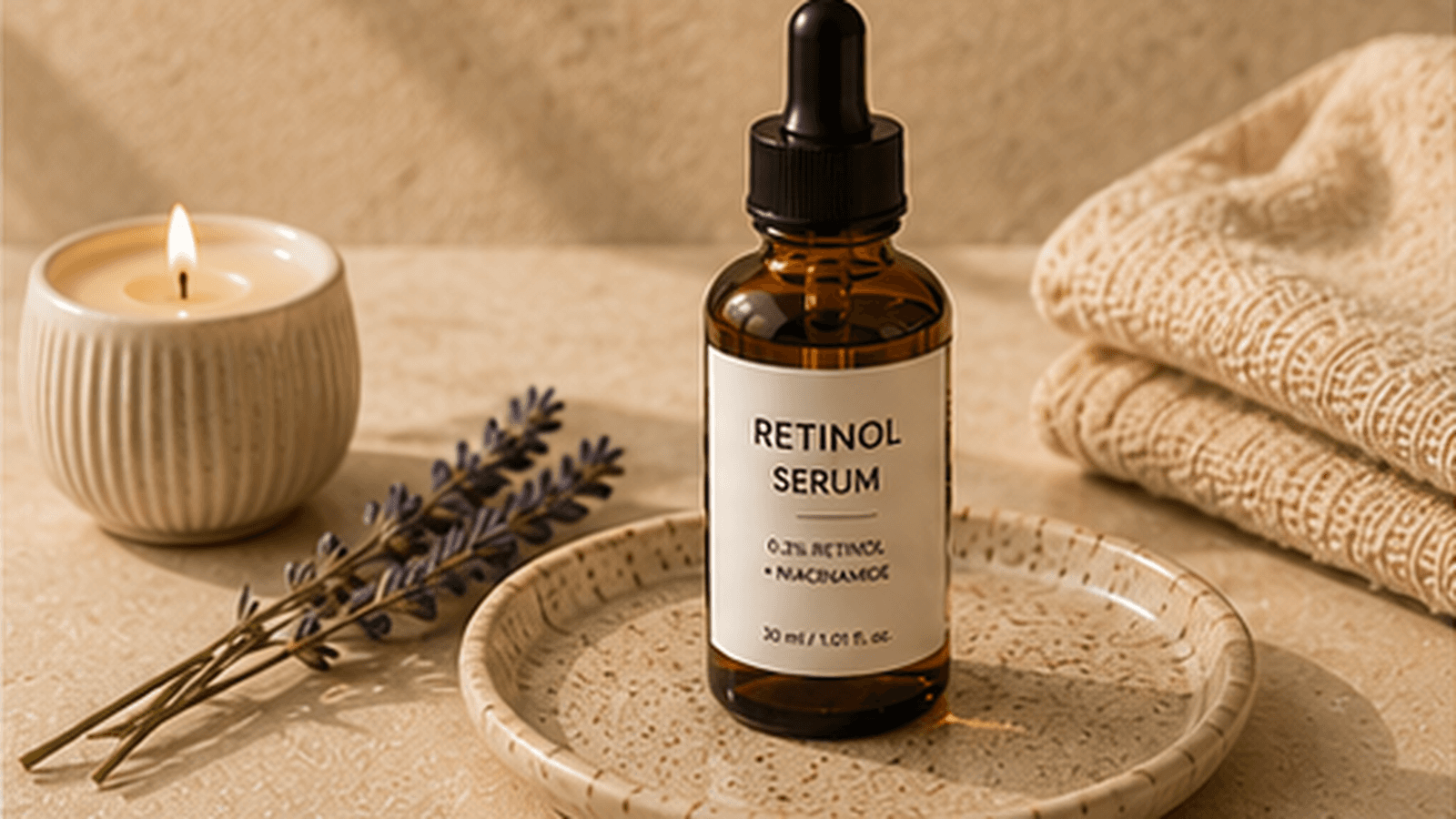
The useful way to start retinol is slower than the marketing. A pea-sized amount, at night, a few times a week, on skin that is clean and dry. That sounds boring. It is how you still have a face in week three.
Retinol is a retinoid. It is not isotretinoin.
Retinol is a form of vitamin A you put on the skin. The American Academy of Dermatology treats "retinoids" as the wider family: prescription tretinoin, adapalene, tazarotene, and over-the-counter retinol. Retinol has to convert in the skin, so it is usually milder and slower than a prescription cream. It is still the same family.
Cleveland Clinic notes that OTC bottles often do not make the percentage obvious. Stronger is not a shortcut you can read off a number. Start with a product you can actually tolerate. Adapalene is a retinoid you can buy without a prescription in many places, aimed more at acne. Tretinoin is prescription. Oral isotretinoin is a different medicine entirely, with a strict pregnancy-prevention programme. A serum in a dropper is not that capsule.
What retinol can reasonably do, over weeks to months: help keep pores from packing, soften the look of fine lines, and even out some marks. Cleveland Clinic says the skin may look worse before it looks better. That early dryness and extra spots are common. They are not a sign to double the dose.
How to introduce it
Patch-test. If a small area is only mildly pink after a couple of days, continue. Cleveland Clinic's outline is: gentle cleanse, pat dry, a thin layer over the face, pea-sized, keep it out of eyes and mouth, then a moisturiser that does not clog pores. For the first couple of weeks, every other night is enough. Some people start twice a week.
The AAD's advice is the same spirit: the least intense formula you can find, every other night, then build. People with darker skin need to watch irritation especially. Inflammation can leave dark marks. Moisturiser and a slow pace reduce that risk. They do not remove it.
If the skin is already red, eczematous or very dry, this is the wrong month. The AAD says retinoids are a poor fit when there is a lot of redness or inflammation; that pattern may be rosacea, which needs different care.
Night, then sunscreen
Use it at night. Retinoids make the skin more sun-sensitive. The AAD wants shade, covering up, and sunscreen on everything clothing does not cover. Cleveland Clinic talks about SPF 30. If you skip that step, you are undoing part of the work and inviting burn. If the two words still fight in your head, sunscreen versus sunblock is a separate explainer. Here the point is only: retinol without daytime protection is a half-routine.
If you are pregnant, or planning to be
This needs a clear line, not a scare story and not a shrug. Oral retinoids can cause birth defects. That is well established. A cosmetic retinol serum is not the same as isotretinoin capsules. Less of a topical product is absorbed through intact skin.
That lower absorption is not a green light. The AAD states retinoids should not be used during pregnancy. Cleveland Clinic notes reports of babies with congenital conditions after topical retinoid use, and says clinicians discourage retinoids in pregnancy because other treatments exist. MotherToBaby, citing ACOG, generally recommends avoiding topical retinoids such as tretinoin and adapalene in pregnancy for the same family reason. The European Medicines Agency takes a precautionary position: topical retinoids must not be used in pregnancy or when planning a pregnancy, even though systemic absorption after proper use is considered negligible.
Practical version: if you are pregnant, trying to conceive, or think you might be, stop retinol and ask a qualified clinician what to use instead. Do not treat this paragraph as permission to keep going because "it is only OTC." Do not treat it as a verdict on a pregnancy that already included accidental use. That is a conversation with your doctor, not a skincare article.
Other bottles in the same bathroom
Cleveland Clinic allows combining retinol with other topicals if you are careful. Niacinamide is often the calmer neighbour and may take the edge off dryness. Vitamin C belongs in the morning for most people, retinol at night. Salicylic acid and glycolic acid can dry you out in the same week; alternate days, or keep the acid as a wash and the retinol as the night step. Use one retinol product, not three.
Redness, peeling and stinging that fade over a few weeks are common. A spreading rash, swelling, or skin that cracks is not. Stop. Give OTC retinol a few months before you decide it did nothing. If acne is moderate, scarring, or tied to other hormonal signs, the AAD wants a dermatologist before you keep escalating the bottle.